Mozambique's Decree 71/2025 on data centres and Decree 72/2025 on cloud computing require providers to be licensed and to keep primary data centres inside the country, while backup and disaster recovery sites may sit abroad if they meet continuity standards. Nigeria's national cloud policy instead takes a risk-based approach keyed to data sensitivity. CIO Africa notes a company active in both markets could face different obligations under one cloud contract.
Digital Parks Africa, part of the Master Power Technologies group, announced Nigeria Data Centre 1, a carrier-neutral Lagos facility for banks, cloud and connectivity providers, at ITW Africa on 8 September 2026; capacity, cost and timeline were not disclosed. The report sets it against a Lagos pipeline of about 146MW and a Central Bank of Nigeria directive that payment data generated in Nigeria be stored locally, with full compliance due on 1 January 2027.
Nigeria's Ministry of Communications, Innovation and Digital Economy has launched a National Digital Cloud Policy that seeks US$750 million of private investment within 24 months and aims to make the country a West African cloud and hosting hub. It covers data centres, cloud and AI compute, applies sovereignty rules to defined categories of government and regulated data, and proposes a National Digital Marketplace to pool ministries' cloud buying. Rollout runs in three phases over two years, alongside Project BRIDGE.
Project BRIDGE, Nigeria's plan for about 90,000km of new fibre reaching all 774 local government areas, has moved into execution with the incorporation of Bridge Open Access as its project company. Private investors are to hold the majority stake and government a minority, and the World Bank, AfDB and EBRD have committed financing, though no amounts or rollout dates were given. Right-of-way disputes and vandalism remain risks.
Wholesale infrastructure firm CSquared said on 13 July 2026 that it has activated capacity on the 2Africa West subsea cable, adding a route alongside its Equiano capacity, which lands in Nigeria and Togo. Its terrestrial backbone carries traffic from landing points such as Accra, Lagos and Abidjan inland to Burkina Faso, Mali, Guinea, Sierra Leone and Liberia. The move follows cable cuts off Cote d'Ivoire in March 2024 and again in June 2026 that disrupted connectivity across the region. No capacity figure was disclosed.
Airtel is putting $120m into a 38MW facility at Eko Atlantic, designed for AI compute rather than general cloud storage, and targeted to be operational by the end of 2026. It would be the largest data centre in Nigeria and the first of five hyperscale sites the group has flagged for Africa.
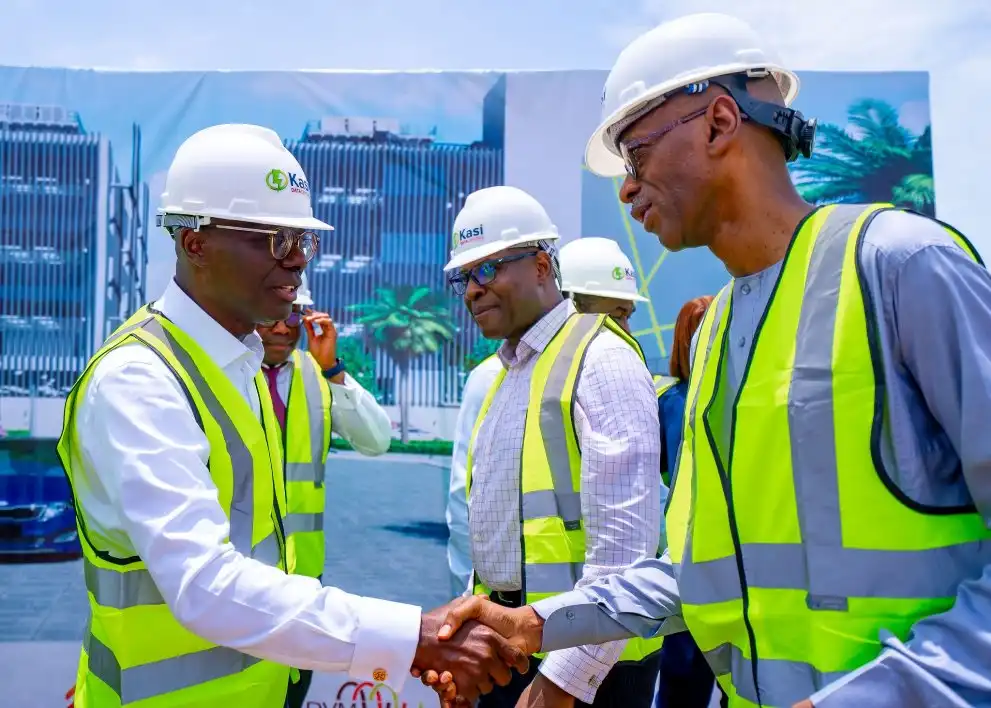
Kasi Cloud has completed LOS1, the first phase of its campus on four hectares at Maiyegun in Lekki, and moved it into commissioning; construction began in 2022 and the full site is designed for about 100MW of IT load. The company points to proximity to six cable landing stations, including Equiano and 2Africa, and to cloud policy rules on in-country hosting of sensitive government and financial data. LOS1's own capacity and the investment were not stated.
Canalink, GUILAB, International Mauritania Telecom, Orange Group, Orange Côte d'Ivoire, Sonatel and Silverlinks have signed an MoU to start Via Africa, a consortium subsea cable from the UK, France and Portugal down the Atlantic coast via the Canary Islands, Mauritania, Senegal, Guinea, Côte d'Ivoire and Nigeria, with extensions further south planned. Members will jointly fund a route study and are preparing a tender to pick a cable supplier; no capacity or delivery date was given. The stated aim is a route that adds diversity to Africa's existing international links.
Balancing Act's African Interconnection Report, commissioned by WIOCC, finds planned carrier-neutral data centres in sub-Saharan Africa fell from 38 to 23, while existing facilities slipped from 75 to 72 and country coverage stalled at 21. It blames smaller operators struggling to sign tenants, weak francophone demand outside Cote d'Ivoire, financing tied to sales milestones, and delays from governments and elections, while consolidation grows. The report also says the Microsoft and G42 Kenya project was pushed back after seismic issues at its Rift Valley site and may move to Nairobi, and that large Nigerian builds have yet to turn into orders.
The African Development Bank has approved a $200 million loan for Nigeria's Project Bridge, part of an $800 million sovereign package that also includes $500 million from the World Bank and $100 million from the EBRD. The project aims to lay 90,000km of open-access fibre, taking the national backbone from about 30,000km to about 120,000km, reach all 774 local government areas and build cross-border links to Benin, Cameroon, Niger and Chad. The bank says design criteria favour hybrid and renewable power for resilience.
Equinix plans more South African data centres under a R7.5 billion (US$438 million) programme pitched at AI demand, having bought further land in Johannesburg and Cape Town totalling 327,000 square metres. The company plans 160MW of additional capacity in the country and funds its South African build from its own balance sheet. Across Africa it reports 409MW operational and 172MW under construction, and it opened a purpose-built Lagos site at the end of 2025. No completion dates were given; the figures come from an Equinix interview with Bloomberg.
NCC board chairman Idris Olorunnimbe and executive vice chairman Aminu Maida visited Airtel’s Lekki facility for a briefing on infrastructure and network expansion plans. Visits like this are the visible end of operator-regulator alignment, which is what decides how fast new capacity clears approval.
Cassava Technologies has put its first Nvidia-based AI factory into service inside its South African data centres and plans further AI infrastructure in Nigeria, Kenya, Egypt and Morocco. South Africa's CSIR is an early user, and Cassava says it will offer local-language services starting with Swahili before adding Zulu and Afrikaans. The rollout sits on its CAIMEx model exchange launched in November 2025; Nvidia is also an equity investor in Cassava. No investment figure or GPU count was disclosed.
Kasi Cloud, backed by Nigeria’s sovereign wealth fund, is building a $250m hyperscale campus in Lekki against a grid that has never sustained more than about 6GW for 230m people. Diesel backup puts operators near $0.40 to $0.50 per kWh where competing markets pay $0.05 to $0.10, which is the gap the 320MW national pipeline has to absorb.
The Internet Exchange Point of Nigeria has installed an authoritative DNS server, using hardware from Canada's CIRA, that answers close to 1,000 queries a second so providers can resolve addresses locally rather than abroad. Chief executive Muhammed Rudman said IXPN has also signed an MoU with Verisign to act as a regional resolution site that could host .com and .net infrastructure in Nigeria. The exchange first passed 1Tbps of peak domestic traffic in April 2025.
Backbone Connectivity Network Nigeria and Equatorial Guinea's transport, telecommunications and AI minister Honorato Evita Oma signed an agreement on principles in Malabo for a new subsea fibre cable between the two countries, also covering cybersecurity cooperation. It follows President Tinubu's August 2024 state visit. The document is a framework only, with no cost, capacity, landing points or schedule disclosed.
TechCabal counts 17 operating data centres in Nigeria with at least nine more under construction or planned, and puts installed capacity at 65 to 86MW, which industry projections see passing 400MW within three to five years. It names Kasi Cloud's $250m Lekki campus (a first phase of 32 to 44.4MW, racks up to 100kW) and Airtel's $120m Nxtra build in Lagos as the likeliest first AI-grade facilities. Operators quoted say imported equipment, currency swings and reliable power remain the binding constraints, and many projects are still being redesigned.
LG3 is the opening phase of a roughly $100m two-year African programme, with the Lagos site slated to open in Q1 2026. Separately Rack Centre began hosting EdgeNext’s CDN and cloud services locally, shortening delivery routes for gaming, fintech and content workloads.
CSquared and its Togolese joint venture CSquared Woezon, with Nigerian operator Phase3 and Benin's state infrastructure company SBIN, have commissioned a terrestrial fibre route from Lagos to Accra that crosses Benin and Togo, with a quoted latency of 11ms between the two cities. The partners present it as an overland alternative to the coastal subsea cables after the March 2024 seabed rockfall that cut several systems and disrupted service for an estimated 300 million people. Route length and capacity were not disclosed, and the ready-for-service date was left to be announced.
Equinix, Kasi, Nxtra by Airtel and OADC are all building close to the eight subsea landing stations on Lagos Island, buying short routes to international capacity and access to cooling water. Nigerian capacity is expected to move from about 64MW to roughly 200MW by 2027, second on the continent behind Johannesburg.
Open Access Data Centres, part of WIOCC Group, set out a $240m multi-phase expansion of its Lagos facility to 24MW, the first 12MW due in 2026. The spend sits inside a wider $500m African build programme aimed at cloud, analytics and AI demand.